4 Apr 2026·8 min read·Greg Turner
Integrating AI with Legacy Systems: A Practical Guide
Most organisations run on systems built years ago. This guide covers proven integration patterns, common challenges, and practical steps to unlock AI value without replacing the technology that keeps your business running.
What This Article Covers
- Understanding why legacy systems persist and why integration, not replacement, is the right approach.
- Identifying the common technical and organisational challenges of AI-legacy integration.
- Evaluating proven integration patterns including data layers, API wrappers, event-driven, RPA, and sidecar approaches.
- Planning an integration project from assessment through proof of concept to production.
- Avoiding the most common mistakes that derail AI integration efforts.
- Building internal capability to sustain integration over the long term.
Who This Article Is For
- Technology leaders managing legacy infrastructure while exploring AI adoption.
- Operations and IT managers responsible for systems that AI initiatives need to connect with.
- Business leaders evaluating AI investment where legacy systems are a consideration.
- Solution architects planning AI integration strategies.
- Teams looking for practical approaches to bridging old and new technology.
Introduction
Most organisations do not operate on clean, modern technology stacks. They run on systems built years or even decades ago, systems that handle critical business processes and contain irreplaceable institutional knowledge. When these organisations look at AI, the first question is rarely “what can AI do?” It is “how do we make AI work with what we already have?”
This is the reality for the majority of Australian businesses. The promise of AI is compelling, but the path to realising it runs directly through legacy infrastructure. ERP systems, custom-built databases, mainframe applications, and ageing middleware all stand between where organisations are today and where AI could take them.
This article provides a practical guide to integrating AI with legacy systems. It covers the common challenges, the integration patterns that work, and the steps organisations can take to unlock AI value without ripping out the technology that keeps them running.
Why Legacy Systems Matter
Before discussing integration, it is worth understanding why legacy systems persist and why they deserve respect rather than dismissal.
Legacy systems exist because they work. They process transactions, manage customer records, handle compliance requirements, and support daily operations. They have been refined over years to handle edge cases and business rules that no one has fully documented. Replacing them is expensive, risky, and often unnecessary.
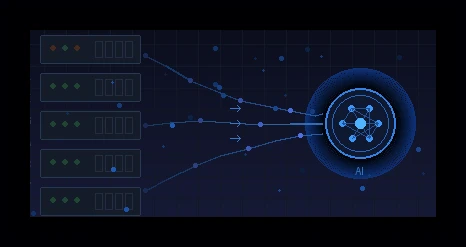
The goal of AI integration is not to replace legacy systems. It is to extend their capabilities. A well-integrated AI layer can extract insights from data locked in legacy databases, automate manual processes that bridge gaps between old systems, and add intelligence to workflows that currently depend entirely on human judgment.
Common Challenges
Integrating AI with legacy systems is not straightforward. Understanding the typical obstacles helps organisations plan realistically and avoid surprises.
Limited or No APIs
Many legacy systems were built before APIs became standard. They may expose data only through file exports, batch processes, or proprietary interfaces. Without clean, real-time access to data, AI systems cannot operate effectively. This is often the first and most significant technical barrier.
Data Quality Issues
Legacy systems frequently contain data that has degraded over time. Duplicate records, inconsistent formats, missing fields, and outdated entries are common. AI systems are sensitive to data quality, and feeding them poor-quality data from legacy sources produces poor-quality results.
Proprietary Technology Stacks
Older systems often use proprietary languages, databases, or protocols that modern AI tools do not natively support. Connecting a Python-based machine learning model to a COBOL application running on a mainframe requires bridging two fundamentally different technology worlds.
Institutional Knowledge Gaps
The people who built and understood the legacy system may no longer be with the organisation. Documentation is often incomplete or outdated. Understanding what data means, how it flows through the system, and what business rules are embedded in the code can require significant reverse-engineering effort.
Performance and Availability
Legacy systems often operate at capacity. Adding AI workloads, whether through data extraction, real-time querying, or process automation, can place additional load on systems that were never designed for it. Performance degradation or downtime in a core business system is a serious risk.
Security and Compliance
Older systems may not support modern authentication, encryption, or audit logging standards. Connecting them to AI platforms, particularly cloud-based ones, creates potential security and compliance gaps that must be carefully managed.
Integration Patterns That Work
There is no single approach to integrating AI with legacy systems. The right pattern depends on the specific systems involved, the data requirements, and the business objectives. However, several proven patterns emerge consistently.
The Data Layer Approach
Rather than connecting AI directly to the legacy system, extract data into a modern data layer such as a data warehouse, data lake, or cloud-based data platform. The AI system then operates on this intermediate layer rather than the legacy system itself.
This approach has several advantages. It isolates the legacy system from AI workloads, so there is no risk of performance impact. It allows data to be cleaned, transformed, and standardised before AI processes it. And it creates a foundation that can serve multiple AI use cases, not just the first one.
The trade-off is latency. Data in the intermediate layer is only as current as the last extraction. For use cases that require real-time data, this may not be sufficient.
The API Wrapper Approach
Build a modern API layer around the legacy system. This wrapper translates between the legacy system's native interface and a standard API that modern AI tools can consume. The wrapper handles authentication, data format translation, and error handling, presenting a clean interface to the AI layer.
This approach provides more real-time access than the data layer approach and allows AI systems to both read from and write to the legacy system. However, it requires a deeper understanding of the legacy system's internals and ongoing maintenance as either the legacy system or the AI layer evolves.
The Event-Driven Approach
Rather than querying the legacy system directly, capture events as they occur. When a transaction is processed, a record is updated, or a workflow step is completed, an event is published to a message queue or event stream. AI systems subscribe to these events and process them as they arrive.
This approach works well for use cases like real-time monitoring, anomaly detection, and automated responses. It minimises the load on the legacy system because it captures events passively rather than actively querying. However, it requires changes to the legacy system to emit events, which may not always be feasible.
The Robotic Process Automation Bridge
For systems with no API access and no ability to be modified, Robotic Process Automation (RPA) can serve as a bridge. RPA bots interact with the legacy system through its user interface, extracting data and performing actions just as a human user would. AI systems can then process the data extracted by RPA or instruct RPA bots to take actions based on AI analysis.
This is often the fastest path to integration because it requires no changes to the legacy system. However, it is fragile. Any change to the legacy system's user interface can break the RPA integration, and it does not scale as well as API-based approaches.
The Sidecar Pattern
Deploy the AI system alongside the legacy system, sharing access to the same database or file system but operating independently. The AI system reads data directly from the legacy system's data store without going through the application layer.
This approach can be effective when the legacy system's database is well-understood and relatively accessible. However, it bypasses the business logic embedded in the application layer, which means the AI system must replicate or account for any data transformations or validations the application performs.
Planning Your Integration
Assess Your Current State
Before selecting an integration approach, conduct a thorough assessment of your legacy landscape. Identify which systems contain the data your AI use case needs. Understand how data flows between systems. Document the interfaces each system exposes. Assess data quality in each source system. Identify who understands each system and its data.
Define Your Requirements
Be specific about what the AI system needs from the legacy system. Does it need real-time data or is batch extraction sufficient? Does it need to read data only, or does it also need to write back? What volume of data needs to flow between systems? What are the acceptable latency and availability requirements?
Start with a Proof of Concept
Do not attempt a full integration as your first step. Build a proof of concept that connects the AI system to a subset of legacy data using the simplest integration approach that meets your requirements. This validates both the technical feasibility and the business value before committing to a larger investment.
Invest in Data Quality
Whatever integration pattern you choose, data quality will determine whether the AI system delivers value. Budget time and effort for data cleaning, standardisation, and governance. This is not a one-time activity. Ongoing data quality management is essential for sustained AI performance.
Plan for Coexistence
AI integration with legacy systems is not a short-term project. These systems will coexist for years, possibly longer. Design your integration to be maintainable, monitorable, and adaptable. Document everything. Build in logging and alerting. Plan for what happens when either the legacy system or the AI system changes.
Build Internal Capability
Successful integration requires people who understand both the legacy systems and modern AI technology. This combination is rare, so plan to develop it. Cross-train your legacy system experts on AI concepts and your AI team on legacy system architecture. The integration will be stronger when both sides understand each other.
Common Mistakes to Avoid
Trying to Replace Everything at Once
The temptation to use AI integration as an excuse for a complete system replacement is strong but almost always leads to failure. Focus on integration, not replacement. The legacy system continues to do what it does well. The AI layer adds new capabilities on top.
Underestimating Complexity
Legacy system integration is almost always more complex than initial estimates suggest. Hidden dependencies, undocumented business rules, and unexpected data issues emerge during implementation. Build contingency into your timelines and budgets.
Ignoring the People
The teams who maintain legacy systems have deep institutional knowledge. Treat them as essential partners in the integration effort, not obstacles. Their understanding of how the system actually works, as opposed to how documentation says it works, is invaluable.
Skipping Governance
When AI systems read from and write to legacy systems, governance becomes critical. Who is responsible when the AI system makes a decision based on legacy data? What happens when the AI system writes incorrect data back to the legacy system? These questions need clear answers before integration goes live.
What are common integration challenges between RPA and legacy or mainframe systems?
The recurring problems are these:
- The interface is the API. RPA drives the legacy system through its screens, so a relabelled field, a changed tab order, or a new mainframe green-screen layout breaks the bot. Expect ongoing maintenance rather than a one-off build.
- Terminal emulation is not browser automation. Mainframe sessions are character-based and often paginated. Bots must handle screen-scraping, field offsets, and timing rather than reading a DOM.
- Batch windows and system load. Many mainframes are near capacity and reserve overnight windows for batch. A fleet of bots querying during business hours competes with the transactions the business actually runs on.
- Credentials, sessions, and concurrency. Legacy systems often limit concurrent sessions per user and lack service accounts, so bots end up sharing human credentials. That creates both a throughput ceiling and an audit problem.
- Auditability. When a bot acts under a human login, the audit trail says a person did it. For regulated work, you need separate bot identities and logging before go-live, not after.
- Data quality. RPA extracts what is on the screen, including duplicates, inconsistent formats, and stale records. Feeding that straight into an AI model produces poor results no matter how good the model is.
- Undocumented business rules. Decades of validations and edge cases are embedded in the application layer. The people who understood them have often left, so a bot that bypasses or mimics those rules incorrectly can corrupt data silently.
- It does not scale like an API. RPA is the fastest route to integration when nothing else is available, and the right choice for low-volume or short-lived cases. For high volume, plan to replace it with an API wrapper or event feed.
How to integrate AI automation with legacy systems
Work through five steps:
- Assess what you have. Identify which systems hold the data the AI use case needs, what interfaces each exposes, how good that data is, and who still understands it.
- Define the requirements precisely. Real-time or batch? Read-only, or write-back as well? What volume, what latency, what availability? These answers, not the technology, select the pattern.
- Choose a pattern that matches the constraints. Extract to a data layer when batch data is enough and you want the legacy system insulated from AI load. Build an API wrapper when you need real-time access or write-back. Use an event-driven feed when the legacy system can emit events and you are doing monitoring or anomaly detection. Use an RPA bridge when there is no API and the system cannot be modified. Use the sidecar pattern when the database is well understood and you can safely bypass the application layer.
- Prove it on a narrow slice. Connect the AI system to a subset of legacy data using the simplest approach that meets the requirements. This validates feasibility and business value before you commit real budget.
- Build for coexistence. These systems will run alongside each other for years. Fix data quality as an ongoing discipline, document the integration, add logging and alerting, and set governance for what happens when the AI writes something wrong back into the system of record.
The point to hold onto is that integration, not replacement, is the goal. The legacy system keeps doing what it does well and the AI layer adds capability on top.
Conclusion: Integration Is the Realistic Path Forward
For most organisations, AI integration with legacy systems is not a compromise. It is the only realistic path forward. The alternative, waiting until all systems are modern before starting with AI, means waiting indefinitely while competitors move ahead.
The organisations that succeed are those that approach integration pragmatically. They respect what legacy systems do well. They choose integration patterns that match their specific constraints. They invest in data quality and internal capability. And they start with focused, manageable projects that deliver value and build confidence.
At Humanising Technologies, we specialise in helping organisations integrate AI with the systems they already have. With 25 years of experience across enterprise technology stacks, we understand both sides of the integration challenge. We build solutions that are practical, maintainable, and designed to deliver value from day one.
Ready to explore how AI can work with your existing systems? Contact us to discuss your integration challenges.
Related reading:
Working through something like this?
A short description of the problem is enough to start.